US Just Recorded Its Warmest September on Record, NOAA Reports
The warmest September on record has pushed temperatures across the contiguous United States to a new high in 2026, according to the National Oceanic and Atmospheric Administration (NOAA). The monthly average reached 69.4°F (20.8°C), beating the previous record set in 1998. Unusually warm nights, widespread heat and contrasting rainfall patterns have raised concerns as the country moves further into fall.
Warmest September on record in the US
September Heat Record: What to Know
-
Record-breaking heat: September 2026 was the warmest September on record across the contiguous U.S., with an average temperature of 69.4°F (20.8°C).
-
Unusually warm nights: Around 80 million people lived in areas that recorded their hottest September nighttime temperatures.
-
Contrasting weather patterns: The Southwest saw exceptional rainfall, while drought continued across roughly 55% of the contiguous U.S.
-
More heat ahead: NOAA's October outlook favors above-average temperatures across several regions, making local forecasts important as fall continues.
NOAA Confirms US Just Saw the Warmest September on Record
The United States has entered fall after experiencing its warmest September in record history.
New data from the National Oceanic and Atmospheric Administration (NOAA) shows that temperatures across the contiguous U.S. reached an unprecedented monthly average, while unusually warm nights and contrasting rainfall patterns added to the weather challenges.
September’s average temperature reached 69.4°F (20.8°C), standing 4.6°F above the 20th-century average.
This surpassed the previous September record set in 1998.
The country has now experienced 20 consecutive months with above-average temperatures, and four months in 2026 — March, July, August and September — have set monthly heat records.
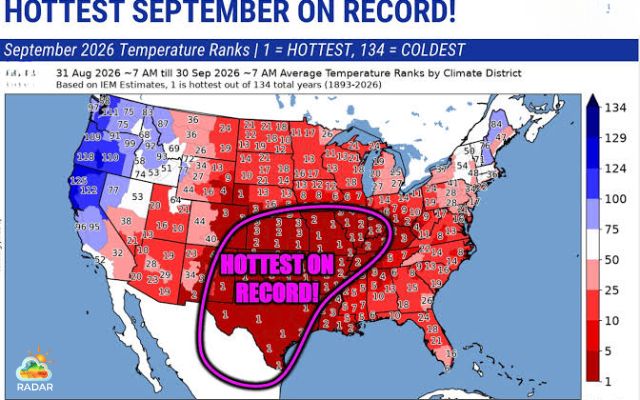
September’s average temperature reached 69.4°F (Photo: BAM Weather)
Warm Nights Stand Out Across Much of the Country
The record was driven largely by elevated nighttime temperatures rather than exceptionally high daytime readings.
The average overnight low exceeded the previous September record, established in 2019, by more than 1.2°F.
Around 80 million people lived in areas that recorded their hottest September nights.
Forty-three states experienced above-average temperatures. Arkansas, Illinois, Kansas, Louisiana, Missouri, New Mexico, Oklahoma and Texas each recorded their warmest September on record.
Oregon, by contrast, was the only state with below-average temperatures.
Southern California also faced another spell of unusual fall heat in early October, with forecasts calling for temperatures near 100°F in parts of the region.
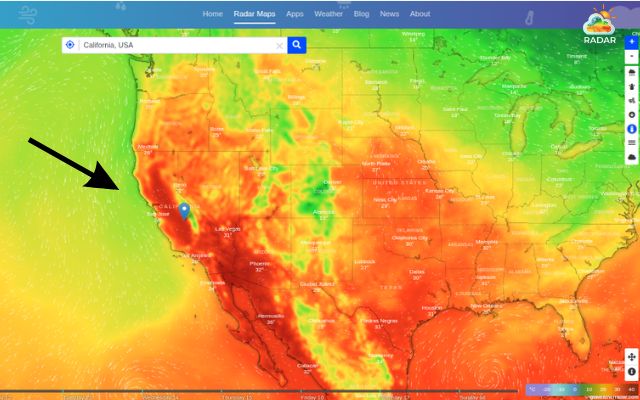
GoWeatherRadar temperature map shows intense heat in California
Learn more about GoWeatherRadar’s Temperature Radar Map!
Rainfall Extremes Leave Some Areas Wet and Others Dry
The heat record did not mean the entire country experienced dry weather. The Southwest received more than twice its average September rainfall.
Arizona recorded its wettest September since 1983, while New Mexico had its wettest since 1941.
Elsewhere, drought remained a major concern. According to the latest U.S. Drought Monitor report cited by ABC News on October 8, approximately 55% of the contiguous U.S. was experiencing drought.
Conditions had expanded or intensified across much of the southern Plains and the Lower Mississippi and Tennessee valleys.
Hawaii also recorded 10.83 inches of September precipitation, its wettest September since 2015, with Hurricane Lowell contributing to the rainfall.
|
Weather Safety Tips |
|
|
Extreme Heat Safety Tips |
Heavy Rain Safety Tips |
|
|
NOAA's monthly outlook favors above-average temperatures across much of the West, northern Plains, Gulf Coast and Florida.
Longer-term global warming raises the likelihood of extreme heat, while natural climate patterns can also influence regional temperatures.
The latest record reinforces the importance of monitoring local forecasts beyond summer. With heat, drought and heavy rainfall affecting different parts of the country, conditions can vary considerably even within the same week.
References
-
ABC News
-
BBC
-
Scientific American


0 Comments
Leave a Comment
Your email address will not be published. Required fields are marked *